Free Download Of A Manual For Honda Acty Mini Truck
| Honda Acty | |
|---|---|
 | |
| Overview | |
| Manufacturer | Honda |
| Production | 1977 - 2021 |
| Assembly | Suzuka Institute, Suzuka, Mie, Nihon Yachiyo Plant, Yokkaichi, Mie, Japan (starting 1985) |
| Trunk and chassis | |
| Class | Microvan Kei truck |
| Torso style | 5-door van 2-door pickup truck |
| Layout | Mid-engine, rear-wheel drive / iv-bike drive. |
| Related | Honda Vamos |
| Chronology | |
| Predecessor |
|
| Successor | Honda Northward-Van (van) |
The Honda Acty ( Japanese: ホンダ・アクティ , Honda Akuti ) is a series of cabover microvans and kei trucks produced by the Japanese automaker Honda from 1977 to 2021, designed for the Japanese domestic market (JDM). "Acty" is short for "Action".
The Acty'due south primary competitors are the Subaru Sambar, Suzuki Carry/Every, Daihatsu Hijet, Mazda Scrum, Nissan NT100/NV100 Clipper and the Mitsubishi Minicab.
History [edit]
The Acty range is designed to exist economic, agile work vehicles, and generally lack luxury options, although air-conditioning and power steering are available along with diverse trim, ornament, and customization options. The first generation was produced from 1977 to 1988 (model series TA, TB, TC, VD, VH), the second generation'south years were 1988-1999 (model serial HA1, HA2, HH1, HH2 with the E05A engine; HA3, HA4, HA5, HH3, HH4 with the EN07A engine - the Street connected in production until 2011) and the third generation'due south years were 1999-2009 (model series HA6, HA7, HH5, HH6 with E07Z engine) with the van yet in production. The 4th generation was introduced, as a truck only, at the 41st Tokyo Motor Show in 2009 on December 17, showing the HA8 series and standing to use the E07Z engine. Since the merger of the Subaru Sambar and Daihatsu Hijet, the Acty truck has become the only remaining Kei truck not to have a front-engine, rear-wheel-drive layout.
Beginning generation [edit]
| First generation | |
|---|---|
 Pre-facelift Acty truck | |
| Overview | |
| Manufacturer | Honda |
| Also called | Honda Street |
| Production | July 1977–1988 |
| Trunk and chassis | |
| Body style |
|
| Layout | Mid-engine, rear-wheel bulldoze / four-wheel drive. |
| Powertrain | |
| Engine | 545 cc EH SOHC 2-cylinder |
| Manual |
|
| Dimensions | |
| Wheelbase | 1,850 mm (72.eight in) |
| Length | 3,195 mm (125.8 in) |
| Width | 1,395 mm (54.9 in) |
| Height |
|
| Curb weight | 590 kg (1,301 lb) (truck) |
The commencement Acty trucks were introduced July 27, 1977, and replaced several Keitoras Honda had previously offered, such as the Honda TN360 (most recently sold as the TN7) and the Honda T360. On 1 September 1975, the Japanese Regime revised the rules on Road Trucking Vehicle Police force that regulated the dimensions and engine size of vehicles in this class. Every bit a upshot, the kickoff Acty trucks and vans were available with a "midship" mounted 545 cc 2-cylinder SOHC water-cooled engine, known as the EH engine, which produces 28 PS (20.6 kW; 27.half dozen hp) at 5500 rpm and 4.2 kg⋅m (41 N⋅m; 30 lb⋅ft) of torque at 4000 rpm. This was well-nigh 50% larger than the engine used in the preceding TN7. Export models, with less emissions equipment, claim 30.6 hp (22.8 kW; 31.0 PS) at the aforementioned engine speed.[one]
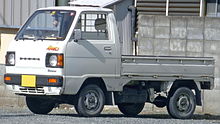
1983 Acty (2d facelift)

1985 Honda Street (late 1st gen)
The van was introduced November 1979, although a truck-based panel van with a indigestible rear was available from the get-go (TB).[2] To save coin, the van uses the same taillights every bit the truck and too has side doors with center mounted handles, meaning that the aforementioned pressing can exist used for either side of the car. The Acty was exported to a number of markets, including Corking United kingdom, where it is considered to have created an unabridged new category. The Suzuki Carry/Bedford Rascal was GM's response to the Acty in the British market.[three]
An upper trim level of the Acty van intended mainly for passenger usage went on sale i February 1981 and was called the Honda Street (in Japanese); information technology was produced for two generations of the Acty van. Available with a standard or an all-new high roof design, the loftier roof was also made bachelor for the Acty van (SDX simply).[4] The name was discontinued in 2001 after the Honda Vamos name had been reintroduced as a replacement trim level for the Street, on a shared platform of the Acty van. In March 1983 the 4-bike drive Acty/Street was added. This model receives 12-inch wheels for increased ground clearance and has an engine with an improved cylinder caput, increasing power to 29 PS (21.3 kW; 28.half-dozen hp) at 5300 rpm and torque to 4.5 kg⋅m (44 Due north⋅m; 33 lb⋅ft) at 3500 rpm.[five] This was also the kickoff Acty/Street to receive a five-speed manual gearbox, initially merely available on the 4WD models. A larger, 35 L (9.2 US gal) was as well part of the 4WD's equipment.[5]
In June 1982 the serial received a facelift, with wraparound turn signals. At this time the Hondamatic version was added, equally was the "Big Cab" version, with a passenger compartment stretched by 100 mm (iv in). While the Acty has round headlamps, the Street received foursquare units after the facelift. Starting with model year 1985, the Acty/Street was exclusive to a concatenation of Japanese Honda dealerships established for small and commercial vehicles, called Honda Primo.
Export versions [edit]
The Acty was also sold in a few consign markets, such as the United Kingdom and Commonwealth of australia. Subsequent models were marketed nearly entirely in the Japanese domestic market simply. As a chip of an oddity, the Acty was sold during 1982 in Australia, but was made unavailable inside of Sydney due to concerns by Honda that the vehicle was underpowered for the hilly terrain.
2nd generation [edit]
| 2d generation | |
|---|---|
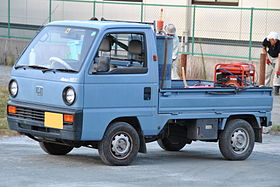 Acty Truck (1988-1989) | |
| Overview | |
| Manufacturer | Honda |
| Too chosen | Honda Street |
| Product | March 1988–May 1999 |
| Body and chassis | |
| Body fashion |
|
| Layout | Mid-engine, rear-bicycle drive / four-wheel drive. |
| Powertrain | |
| Engine |
|
| Manual |
|
| Dimensions | |
| Wheelbase | ane,900 mm (74.8 in) |
| Length | 3,195–3,295 mm (125.viii–129.seven in) |
| Width | 1,395 mm (54.9 in) |
| Height |
|
| Adjourn weight | 670–870 kg (one,477–1,918 lb) |
The second generation Acty was launched in March 1988 with the introduction of the Honda E05 engine, with an boosted cylinder added, making it a 547 cc 3-cylinder with SOHC. The engine is rated 34 PS (25 kW) at 5500 rpm and 4.5 kg⋅m (44 N⋅thousand; 33 lb⋅ft) of torque at 5,000 rpm.[6] The kickoff models were the Acty truck and van, with the commercial grade Acty van actualization a calendar month afterward. The 4WD models (HA-iv) were no longer available with an automatic manual. There was also an "Acty Attack" version of the truck, intended for farmers in particular this model has a differential lock in the rear and features Ultra-Low forward and contrary gears (UL/UR). The other models of STD, SDX, SDX2 and TOWN had slight variations with the Town and SDX2 adding a colour coded (white) bumper and side mirrors along with a tachometer. The Boondocks features tweed seats with a brownish interior (equally opposed to "vinyl" similar seats on STD models). The just other notable options were a calorie-free for rear work area and radio.[six]

1992 Honda Acty van (first facelift)
The 1988-1989 Actys take distinct round headlights (known as "round-eye") while the Street Van has large, rectangular headlamps.[half dozen] Later on the March 1990 facelift the Acty Truck received the same headlights as the Street Van, while all models grew longer by x cm (iii.9 in) every bit the result of altered kei car regulations. At this time the Street too received the taillights from the contemporary Honda Today (which were besides used for the third generation Acty van). The 1990 changeover as well meant that the 547 cc engine was replaced with the larger 656 cc Honda E07A engine (with fuel injection added in 1996). The carburetted version of this engine produced 38 PS (28 kW) at v,300 rpm and v.5 kg⋅m (54 N⋅m; 40 lb⋅ft) of torque at 4,500 rpm. The Street could accomplish a height speed of 115 km/h (71 mph), while the four-bike drive version but could attain 105 km/h (65 mph).[7]

Postal service-1996 Honda Acty truck (terminal facelift)
In October 1993 the Honda Street's front blueprint was changed still once again, receiving larger, more square headlamp units. A PGM-FI version in "Pull a fast one on" and "Eleven" equipment levels was likewise introduced to the Street at this time. This version produces 44 PS (32 kW; 43 hp). The front end changes were applied to the Acty likewise, beginning in January 1994. The Acty Crawler was also released for the 1994 model twelvemonth. The Acty and the Street were further modified in January 1996 when the plow signals were inverse from bister to clear. At this time, the fuel injected Acty SDX-Hi was also introduced - only with two-cycle drive and a five-speed manual - with the same engine as the Street Xi (the Pull a fast one on was dropped, replaced by the carburetted Street V). Production of the Acty continued until the inflow of the tertiary generation in 1999, although the Honda Street continued to be built until 2001 as it was only partially replaced past the pricier Honda Vamos.
Third generation [edit]
| Third generation | |
|---|---|
 | |
| Overview | |
| Manufacturer | Honda |
| Production |
|
| Torso and chassis | |
| Torso style |
|
| Layout | Mid-engine, rear-wheel drive / 4-bike drive. |
| Related | Honda Vamos |
| Powertrain | |
| Engine | 656 cc E07Z SOHC I3 |
| Transmission |
|
| Dimensions | |
| Wheelbase | 2,420 mm (95.3 in) |
| Length | 3,395 mm (133.7 in) |
| Width | ane,475 mm (58.ane in) |
| Height |
|
| Adjourn weight | 800–i,030 kg (1,764–2,271 lb) |
| Chronology | |
| Successor | Honda North-Van |
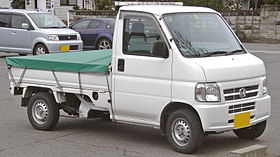
The 3rd generation Acty truck was introduced on 27 May 1999. The van went on sale ane month later.[viii] On September thirty, 1996, the Japanese Regime amended the Enforcement Regulations Vehicle Police, Ministerial Ordinance No. 53, which addressed rubber requirements for front passengers, merely did not allow for larger overall dimensions. Honda pushed the driving position back while keeping the engine in its traditional location underneath the vehicle. The new design retained the mid-engined, rear-bicycle-drive layout although it was now of a "semi-bonneted" design. Coming together the increased rubber requirements was a major focus during development.[viii] The base of operations cost of the pickup model is ¥777,000 (approximately $seven,920 USD), with the van starting at ¥i,060,500 (approximately U.s.a.$10,810) as of Dec 2008. Four-cycle drive is available as an selection on all vans, and all merely i model of pickup truck, making the Acty i of a handful of mid-engine, AWD vehicles that are non designed as supercars.

1999 Honda Acty van (3rd generation)
The 656 cc engine is of an LEV pattern, with low emissions and high gas mileage. Fuel economic system was further increased past the use of electric power steering. Max power in 1999 was 46 PS (34 kW; 45 hp) at 5,000 rpm. The engine was since upgraded to the electric current 660 cc 12-valve inline-three E07Z gasoline engine making 53 PS (39 kW; 52 hp) at 7,000 rpm and 6.2 kg⋅1000 (61 N⋅m; 45 lb⋅ft) of torque at 4,000 rpm (4WD models). Currently, the maximum payload is 200 kg (440 lb). The truck was available as a bones standard model, SDX (Super Deluxe) and more comfortable Town versions. There was besides the Acty Attack, a spartanly equipped four-cycle drive version with a differential lock, particularly intended for farmers. The van was available as a two-seater Pro-B (with sectionalization) or as the somewhat more comfortable Pro-A. There were also four-seater SDX and Town versions.[eight] The Acty van (and the related Vamos Hobio) kept using the taillights of the 1988 facelift version of the Honda Today.
The "Street" proper name was discontinued in favor of the Honda Vamos, based on the Acty van. In Dec 2009 the Acty truck was replaced past the new fourth generation model, simply the bonneted Acty van continued to be produced with the third generation bodywork. On 12 July 2018, the Acty van was discontinued and it was replaced by the Northward-Van.
Fourth generation (truck) [edit]


On 17 Dec 2009, the quaternary generation Acty truck was introduced. Equally for the Daihatsu Hijet and Suzuki Carry competitors, this model has go delinked from the van as a issue of differing safety requirements for commercial vehicles and passenger-blazon vans. Information technology continues to use the predecessor and van's E07Z engine, although now with 45 PS (33 kW; 44 hp). The chassis codes are HA8 (2WD) or HA9 (4WD). The wheelbase was shortened dramatically, returning to the 1.9 chiliad (vi.two ft) as used on the 2nd generation Acty, in order to increment cabin infinite and to compress the turning circumvolve. In June 2012, the Acty underwent some light modifications so as to meet new upcoming standards on lighting.
In November 2018, Honda renewed the "Spirit Color Fashion", a special-purpose vehicle commemorating the 55th ceremony of T360, the origin of Honda's four-wheeled vehicle, based on the "Boondocks" type, in the calorie-free commercial vehicle "ACTY TRUCK" released on November nine.[nine]
Discontinuation [edit]
The Acty ended production in April 2021 due to new emissions regulations and mandatory crash mitigation brakes that must exist installed sequentially, thus increasing development costs.[10] [11]
References [edit]
- ^ Wren, Tim (June 1986). "Low-cal Match". TRUCK. London, Britain: FF Publishing Ltd: 78.
- ^ 自動車ガイドブック [Japanese Motor Vehicles Guide Volume 1978/1979] (in Japanese), vol. 25, Nippon: Japan Automobile Manufacturers Clan, 1978-10-10, p. 209, 0053-780025-3400
- ^ Wren, p. 76
- ^ ホンダ軽商用車アクティシリーズを充実好評のアクティ・シリーズにハイルーフ仕様を追加新発売。 [Honda adds a high-roof model to its popular Acty series of kei commercial vehicles] (Press Information) (in Japanese). Honda Motor Co. 1981-01-27. Retrieved 2014-09-26 .
- ^ a b 扱いやすく、燃料経済性に優れた5速タイプの「ホンダ アクティ4WD」を発売 [Easy to handle and with first-class fuel economy, the five-speed Honda Acty 4WD is released] (Printing Information) (in Japanese). Honda Motor Co. 1983-03-09. Retrieved 2014-09-26 .
- ^ a b c 四輪製品ニュース [4-wheeled product news] (Press Information) (in Japanese). Honda Motor Co. 1988-05-10. Archived from the original on 2018-02-01.
- ^ Quattroruote: Tutte le Auto del Mondo 1992 (in Italian). Milano: Editoriale Domus Southward.p.A. 1992. p. 382.
- ^ a b c 新規格の軽商用車: 新型「アクティ・トラック/バン」を発売 [Kei cars to the new regulations: New Honda Acty truck and van] (Press Data) (in Japanese). Honda Motor Co. 1999-05-27. Retrieved 2014-09-25 .
- ^ "Spirit Color Mode," a special-purpose vehicle - Honda(eleven/13/2019)
- ^ Kobuna, Kouichi (2020-03-15). "【なぜ?】ホンダ、軽トラックから撤退する理由とは 後継車種の予定もなし" [Why? The reason for Honda withdrawing from kei trucks is that there is no program for a successor model] (in Japanese). Autocar Nippon.
- ^ Masato, Hayato (2019-eleven-08). "【アクティトラック生産終了へ!】素晴らしき技術の塊! 軽トラックは日本の宝だ" [The Acty Truck to end production: A fantastic block of applied science! A light truck is a Japanese treasure]. Best Car (in Japanese).
External links [edit]
 | Wikimedia Commons has media related to Honda Acty. |
- Honda Acty Truck webpage
- Honda Acty Van webpage
- ThisOldHonda.org Acty
- Honda Acty Talk and Information
DOWNLOAD HERE
Posted by: roperrety1978.blogspot.com